
Geode Identification Chart
A printable geode identification chart for rockhounds, teachers and families: common geode interiors from quartz and amethyst to calcite and celestine, how to tell a geode from an ordinary rock, famous collecting areas, safe cracking methods, a field log and specimen labels.
- Instant download
- Editable Excel & Word
- Print-ready PDF
- 7-day refund
7 files · PDF, XLSX, DOCX
Geode Identification Chart Pack
Geode ID chart, is-it-a-geode checklist, localities sheet, cracking guide, Mohs hardness card, field log workbook and specimen labels.
- Geode identification chart (PDF, XLSX)
- Is it a geode? checklist (PDF, DOCX)
- Famous localities (PDF)
- + 4 more
$6.00 USD, one-time 7 files · about $0.86 each
- Instant download
- 7-day refund
- Secure checkout by Stripe
7-day money-back guarantee. Full refund within 7 days of purchase, even after you download.
Free sample: Geode Identification Chart (PDF, 97 KB)
Geode Identification Chart Pack
Geode ID chart, is-it-a-geode checklist, localities sheet, cracking guide, Mohs hardness card, field log workbook and specimen labels.
- Geode identification chart (PDF, XLSX)
- Is it a geode? checklist (PDF, DOCX)
- Famous localities (PDF)
- Cracking guide (PDF, DOCX)
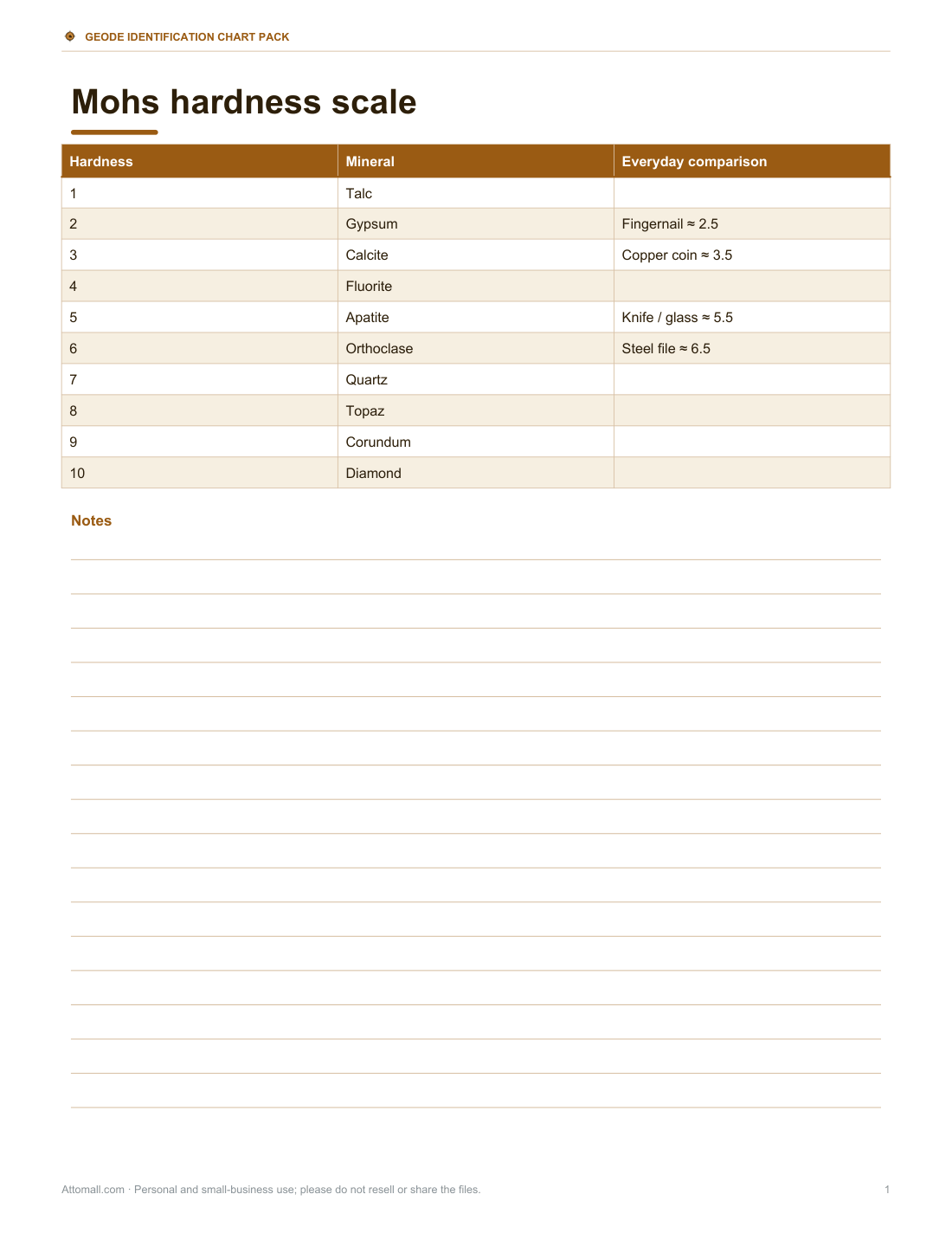
- Mohs hardness card (PDF)
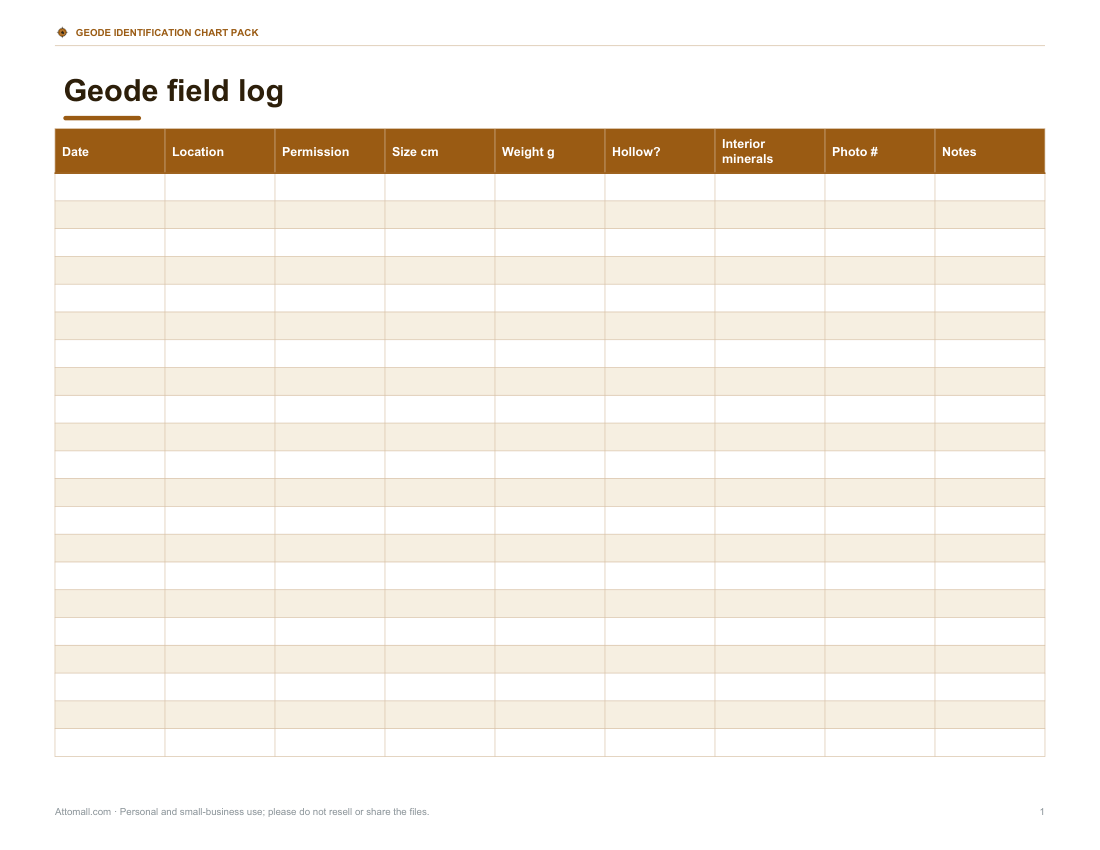
- Field log (Excel)
- Specimen labels (DOCX, PDF)
Formats: PDF, XLSX, DOCX. Instant download after payment (link valid 72 hours, up to 5 downloads). AI-assisted: the templates were drafted with AI help and reviewed and laid out before publishing.
$6.00 USD, one-time 7 files · about $0.86 each
- Instant download
- 7-day refund
- Secure checkout by Stripe
7-day money-back guarantee. Full refund within 7 days of purchase, even after you download.
Free sample: Geode Identification Chart (PDF, 97 KB)
Full refund within 7 days — see the refund policy and license.
Free printables
Single sheets you can print right now, no sign-up. The full pack adds every sheet in one download plus the editable files.
 Printable Geode Identification Chart1 page · free PDF
 Printable Geode Identification Checklist1 page · free PDF
 Printable Geode Localities Chart1 page · free PDF
 Printable Geode Cracking Guide1 page · free PDF
 Printable Mohs Hardness Card1 page · free PDF
 Printable Geode Field Log2 pages · free PDF
 Printable Geode Identification Labels1 page · free PDF
What is in the geode ID pack
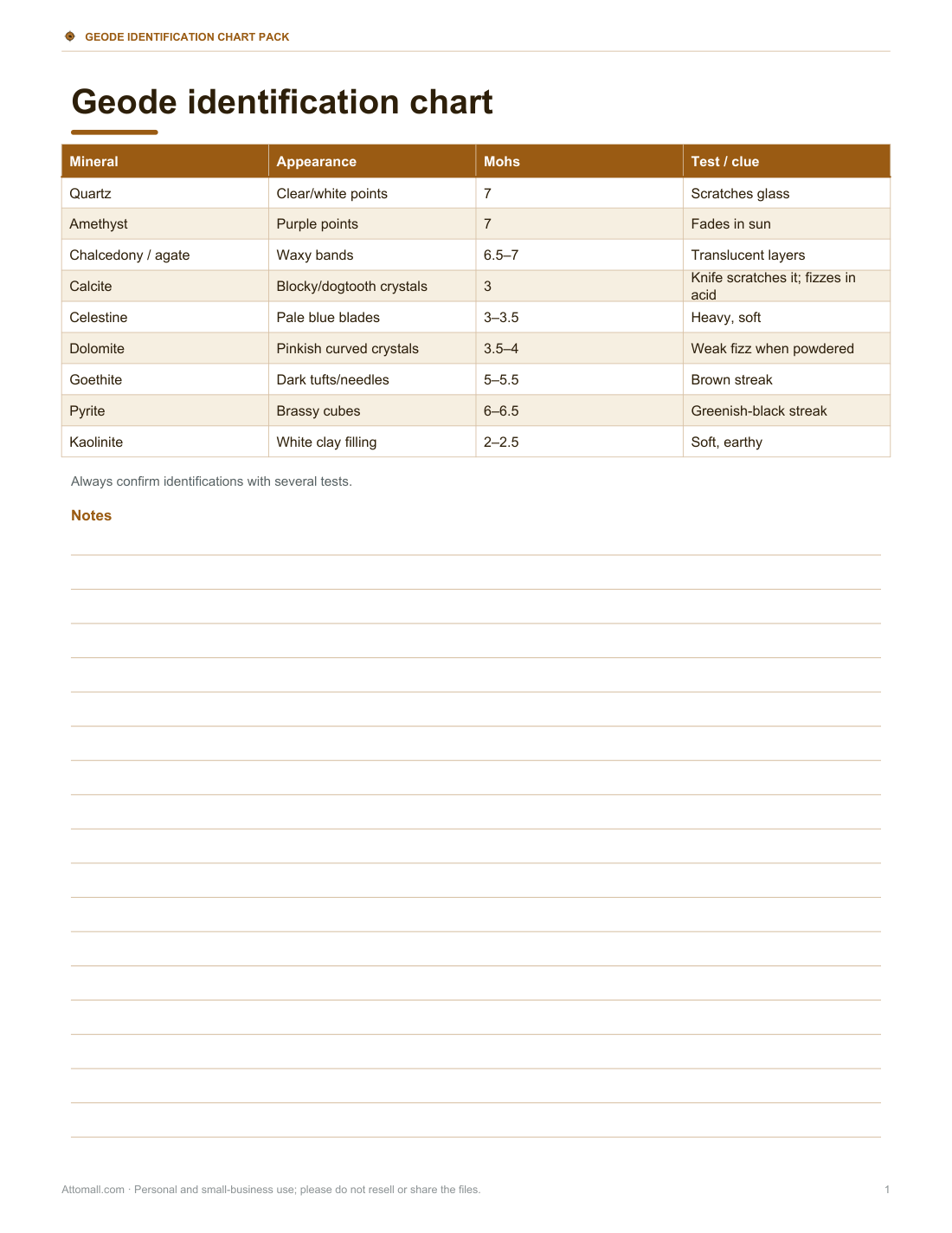
- Geode identification chart — common interiors: clear quartz, amethyst, chalcedony and agate banding, calcite, celestine, dolomite, goethite and more, with appearance and hardness clues.
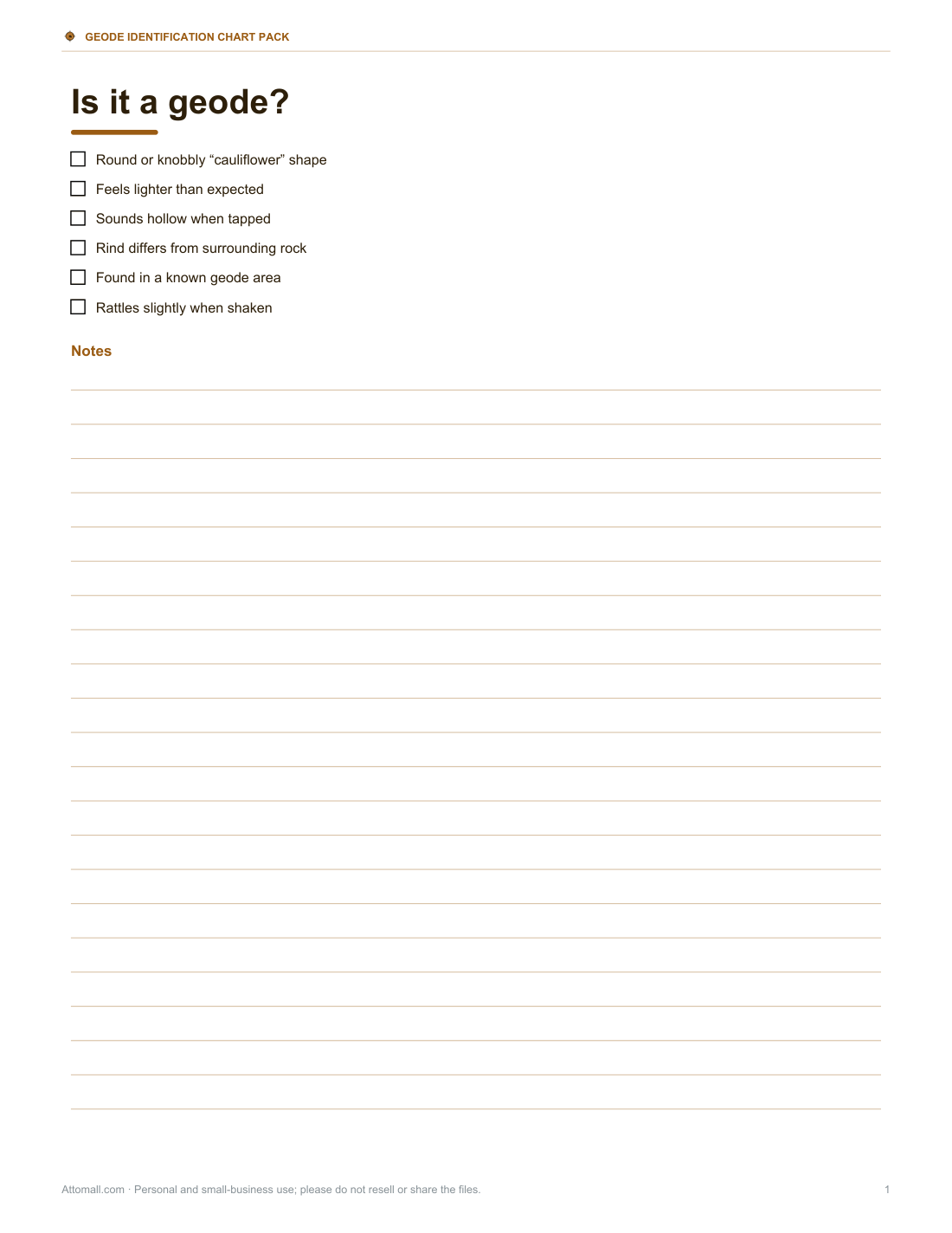
- Is it a geode? checklist — weight, shape, surface texture and sound clues for field identification.
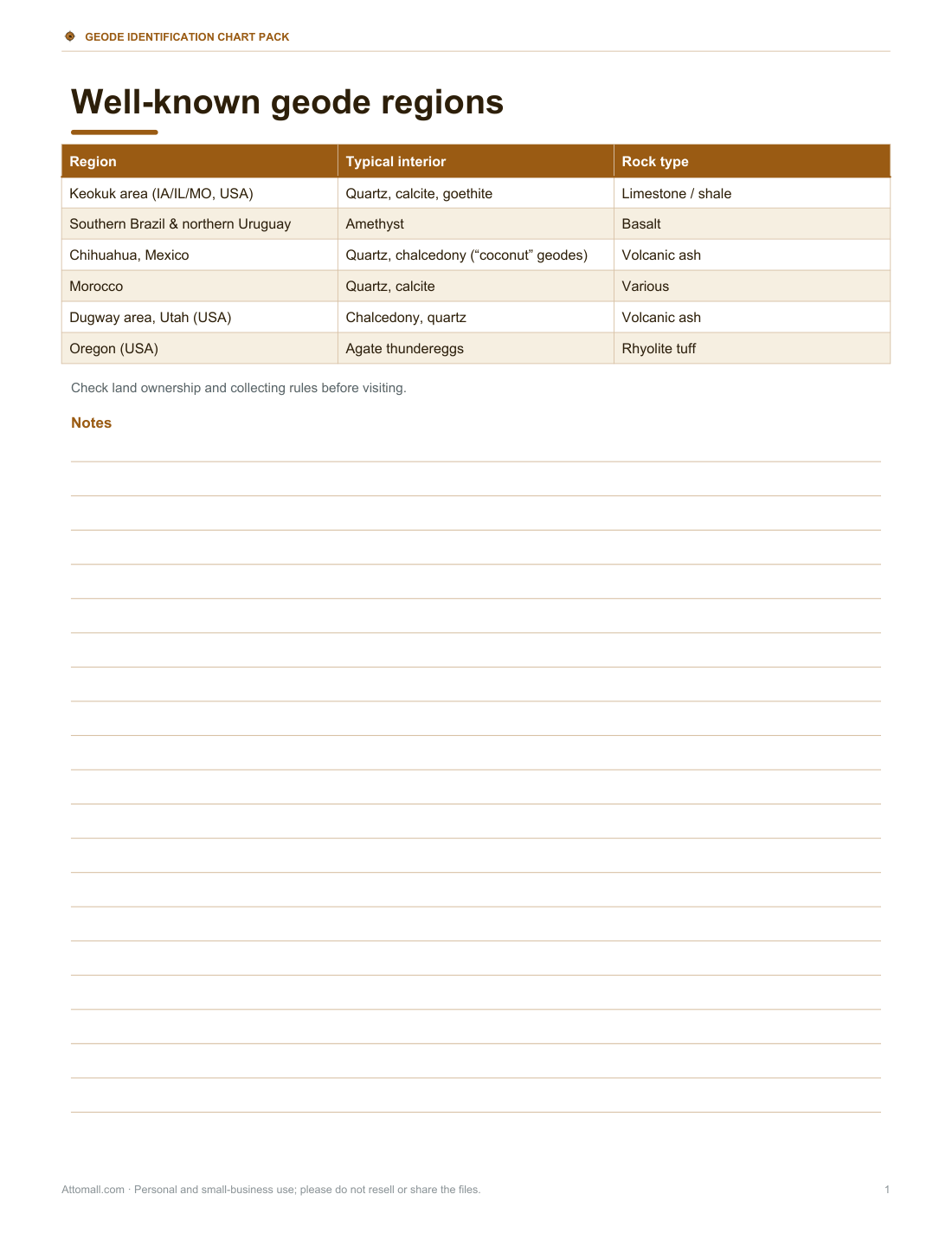
- Famous geode localities — well-known regions, with a reminder to check collecting rules.
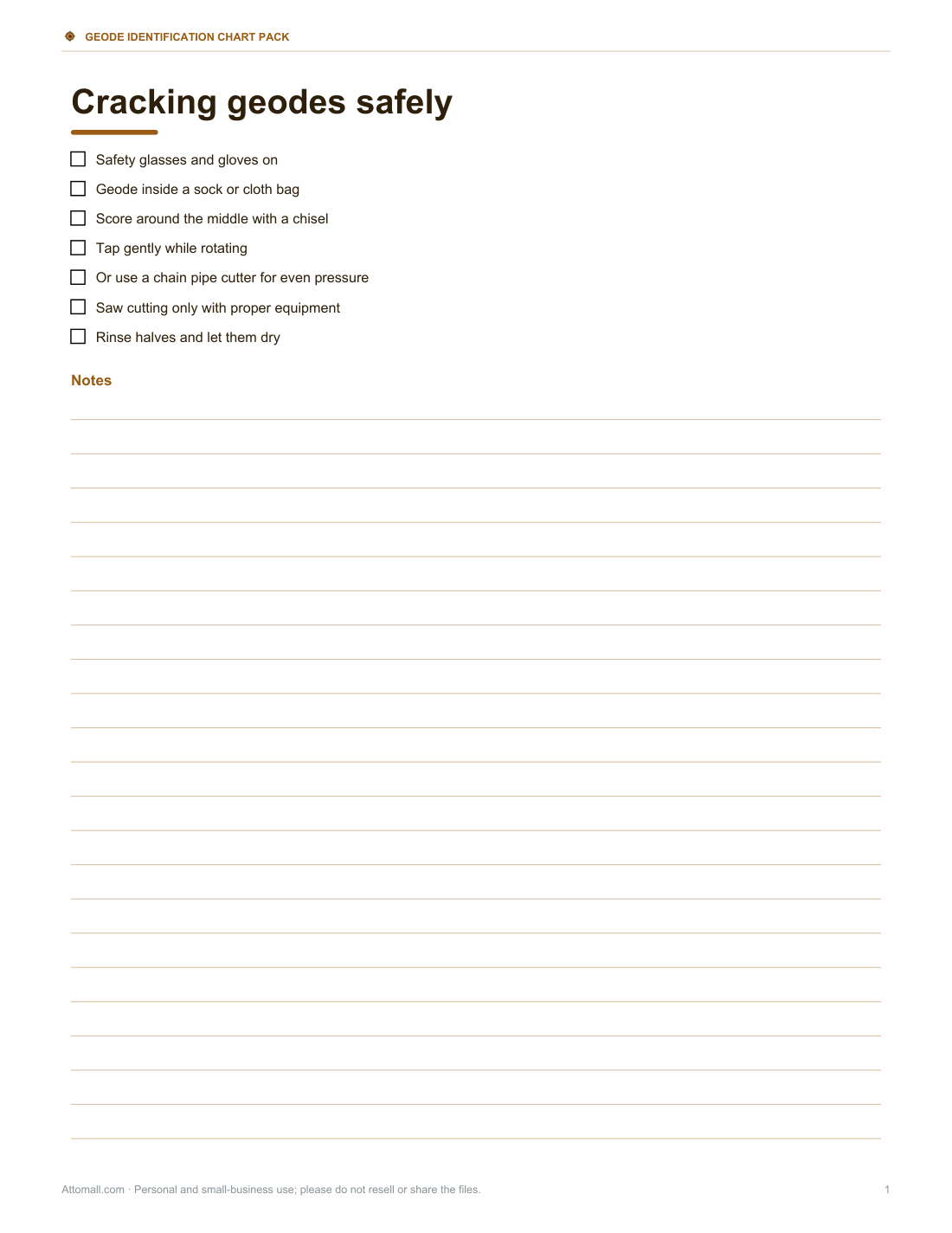
- Cracking guide — hammer and chisel, chain pipe cutter, and saw methods with safety steps.
- Mineral hardness card — the Mohs scale with simple scratch tests.
- Field log (Excel) — record where and when each specimen was found, what was inside and photos.
- Specimen labels — printable labels for a display collection.
What a geode is
A geode is a rock with a hollow interior lined with crystals or bands of mineral. Most form when a cavity — a gas bubble in volcanic rock, or a space left by a dissolved nodule in sedimentary rock such as limestone — slowly fills with mineral-rich water. Over long periods, minerals precipitate on the walls: first often a layer of chalcedony, then crystals growing inward. If the cavity fills completely, the result is a solid nodule rather than a hollow geode; banded ones are often called agates or thundereggs.
Common geode interiors
| Mineral | Appearance | Mohs hardness | Clue |
|---|---|---|---|
| Quartz | Clear to white pointed crystals | 7 | Scratches glass; six-sided points |
| Amethyst | Purple quartz crystals | 7 | Colour fades in long sunlight |
| Chalcedony / agate | Smooth, waxy, banded layers | 6.5–7 | Translucent bands, no crystal points |
| Calcite | White, yellow or brown blocky or dogtooth crystals | 3 | Scratched by a knife; fizzes in dilute acid |
| Celestine | Pale blue bladed crystals | 3–3.5 | Heavy for its size; soft |
| Dolomite | Pinkish curved crystals | 3.5–4 | Slow fizz in dilute acid when powdered |
| Goethite | Dark brown to black tufts or needles | 5–5.5 | Often with quartz in some Midwest US geodes |
Hardness is measured on the Mohs scale: a steel knife is about 5.5 and glass about 5.5, so quartz scratches both, while calcite is scratched by them.
How to tell a geode from an ordinary rock
- Round or cauliflower-like shape with a bumpy, knobbly surface.
- Lighter than a solid rock of the same size, if hollow.
- A hollow sound when tapped gently, or a slight rattle if loose crystals are inside.
- Found where geodes are known to occur, often weathering out of limestone or volcanic ash.
- A different-looking rind from the surrounding rock.
Famous geode regions
Keokuk geodes from the area where Iowa, Illinois and Missouri meet are among the best known in the United States, often lined with quartz and calcite. Large amethyst geodes come from volcanic basalts in southern Brazil and northern Uruguay. Mexico is known for “coconut” geodes from Chihuahua, and Morocco supplies many of the small geodes sold in shops. Utah and Oregon are famous for geode and thunderegg beds. Before collecting anywhere, check land ownership and local rules — many areas require permission, and some protected lands prohibit collecting.
Cracking geodes safely
- Wear safety glasses and gloves; rock chips fly.
- Place the geode in a sock or cloth bag to hold the pieces together.
- Use a small sledge hammer and cold chisel: tap around the middle, rotating the geode, until it splits.
- A chain-type pipe cutter squeezes evenly and gives cleaner breaks.
- A lapidary saw gives the cleanest halves for display but needs proper equipment and training.
Formats
The chart, checklists and guides are print-ready PDFs sized for US Letter; the chart also comes as an editable Excel table. The field log is an Excel workbook and the specimen labels are an editable Word file.
Using the chart with children and classes
Geodes make memorable science lessons: students can predict what is inside from weight and sound, crack one safely under supervision, then identify the minerals with the chart and a simple hardness test. Discuss how long crystal growth takes and why cavities fill in layers, and compare geodes with solid nodules. The field log and specimen labels turn a single activity into a small collection project, practising careful observation and record-keeping.
Frequently asked questions
How can I tell if a rock is a geode?
Look for a round, bumpy rock that feels light for its size and sounds hollow when tapped.
What is the most common mineral inside geodes?
Quartz, including chalcedony and amethyst, is the most common.
Why is my amethyst geode fading?
Long exposure to direct sunlight can fade amethyst's purple colour.
Can I collect geodes anywhere?
No. Check land ownership and local rules; many areas need permission or prohibit collecting.
Was AI used to create this pack?
The charts and guides were drafted with AI assistance and then checked, edited and formatted before publishing.